
To choose the right hardscape contractor, verify their license and insurance, review at least 5–10 photos of completed projects similar to yours, get a minimum of three written quotes, and ask specific questions about base preparation, drainage, warranty terms, and payment schedule before signing anything. A qualified hardscape contractor should carry general liability insurance (typically $1M), workers’ compensation coverage if they have employees, and any state or local contractor license required in your area.
Red flags include contractors who demand full payment upfront, can’t provide references, avoid discussing permits, or give a quote significantly lower than competitors without a clear explanation — often a sign of corner-cutting on base materials, which causes settling and cracking within a few years. Hardscaping — patios, retaining walls, walkways, outdoor kitchens, and fire features — is a major investment where poor workmanship shows up literally in cracks, sinking, and drainage failures within a season or two. This guide covers exactly what to look for, what to ask, and how to compare bids so you hire the right pro the first time. If you are also planning plantings, see our pool landscaping ideas for plants, hardscaping, and privacy.
What to Look For in a Hardscape Contractor
Licensing and Insurance
Requirements vary by state, but at minimum confirm the following before you hire any hardscape contractor:
- Contractor’s license — required in most states for jobs above a certain dollar threshold; check your state’s licensing board.
- General liability insurance — protects you if property is damaged during the project.
- Workers’ compensation insurance — protects you from liability if a worker is injured on your property.
- Ask for a certificate of insurance (COI) directly from their insurer, not just a verbal assurance.
You can verify licensing requirements and file complaints through the U.S. government’s state consumer protection directory.
Portfolio and Reviews
Ask to see a portfolio of at least 5–10 completed projects similar in scope to yours (patio, retaining wall, driveway, etc.), and check third-party review platforms rather than relying solely on testimonials on the contractor’s own website. Look specifically for:
- Projects that are at least 2–3 years old, so you can see how the work has held up over time — fresh installs always look good; settling and drainage issues show up later.
- Consistency in joint lines, paver leveling, and edge restraints.
- Whether they’ve handled a similar material (pavers vs. natural stone vs. poured concrete) to what you’re planning.
Manufacturer Certifications
Many paver and retaining wall manufacturers like Belgard, Unilock, and Techo-Bloc offer installer certification programs. A certified installer has been trained on proper base prep and installation techniques for that specific product line, and some manufacturer warranties are only valid when installed by a certified contractor.

Questions to Ask Before Hiring a Hardscape Contractor
- Can I see your license and proof of insurance? Any legitimate contractor should provide this without hesitation.
- What’s your base preparation process? Proper excavation depth, compacted gravel base thickness (typically 4–8 inches depending on application), and geotextile fabric use are the difference between a patio that lasts 20 years and one that heaves within 3.
- How do you handle drainage and grading? Ask specifically about slope percentage (usually 1–2% away from structures) and any drainage solutions (French drains, channel drains) for your site.
- What’s included in the warranty, and for how long? Get this in writing — reputable contractors typically offer 1–5 year workmanship warranties in addition to manufacturer material warranties.
- What’s your payment schedule? See the section below on red flags related to payment.
- Who will be on-site day to day? Some companies sell the job with an experienced estimator but send a subcontracted crew — know who’s actually doing the work.
- Do I need a permit for this project? Retaining walls above a certain height (often 3–4 feet) almost always require a permit and engineering review; a contractor who says “don’t worry about it” on a wall that clearly needs one is a red flag.
- Can you provide references I can call? Ask for at least 2–3 recent clients you can contact directly.
Red Flags to Watch For
- Demands full payment upfront before any work begins — a deposit of 10–30% is standard; the rest should be tied to project milestones.
- No written contract or a vague scope of work.
- Unusually low bid compared to other quotes without a clear explanation — often means inadequate base depth, no geotextile fabric, or unlicensed labor.
- No local address or verifiable business history.
- Pressure tactics like “this price is only good if you sign today.”
- Reluctance to discuss permits for projects that clearly require them (retaining walls, structures with roofs, electrical/gas work).
- No insurance certificate available on request.
Comparing Bids: What “Apples to Apples” Actually Means
Bids can vary by thousands of dollars for the same visible square footage, and the difference is almost always in what’s beneath the surface. When comparing three quotes from any hardscape contractor, line up the specifications side by side using the comparison below. A bid that’s 20–30% cheaper is worth a direct conversation about exactly what’s being cut.

Typical Cost Ranges for Common Hardscape Projects
Costs vary significantly by region, material choice, and site accessibility, but the ranges below give you a realistic baseline when evaluating a hardscape contractor’s quote.

Contract Essentials and Payment Schedules
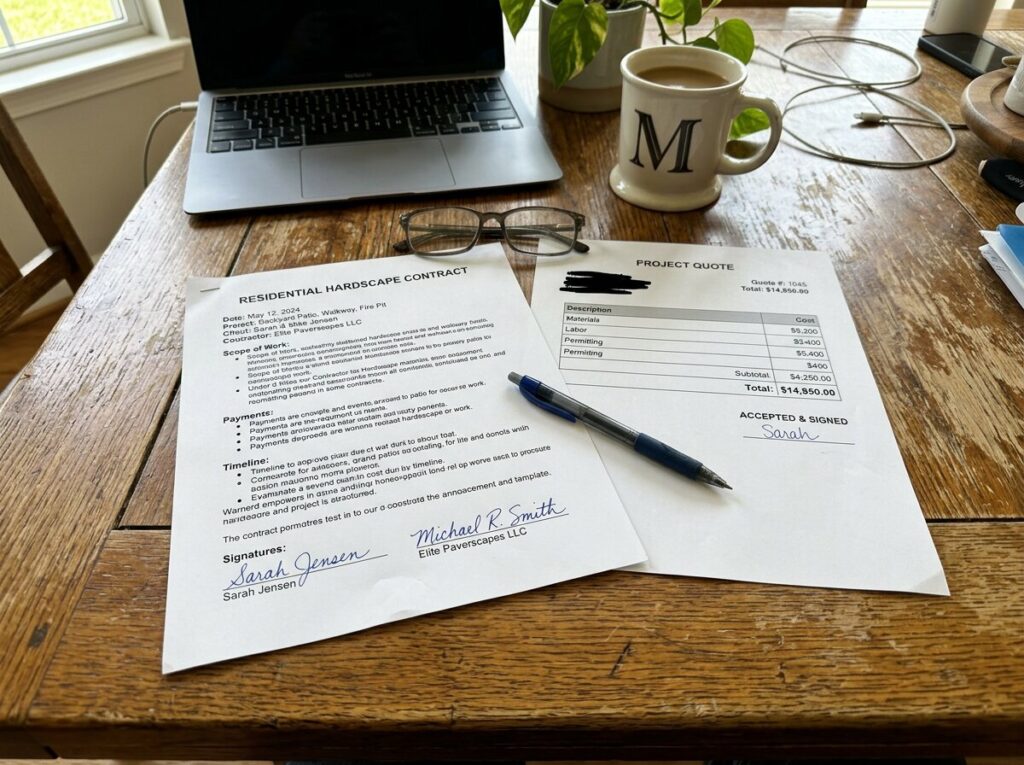
A solid hardscape contract should include:
- Detailed scope of work (materials, brands, dimensions, base specs).
- Start and estimated completion dates.
- Total price with a clear payment schedule (commonly deposit at signing, progress payment at material delivery or midpoint, final payment at completion and your sign-off).
- Change order process — how added costs for unexpected issues, like discovering utility lines or poor soil, will be handled.
- Warranty terms in writing.
- Cleanup and disposal responsibilities.
Never pay the full balance before final walkthrough and your approval of the completed work.
DIY vs. Hiring a Hardscape Contractor
Simple projects like a small paver walkway or a single-tier low retaining wall under 3 feet are within reach for a motivated DIYer with the right tools and a weekend or two. However, larger patios, engineered retaining walls, anything involving drainage engineering, or
projects requiring permits are best left to a licensed hardscape professional — mistakes in base prep or drainage are expensive after the fact, often requiring full removal and redo.

When to Call a Pro
Even confident DIYers should call a licensed hardscape contractor for:
- Retaining walls over 3–4 feet tall (structural engineering and permits typically required).
- Any project involving gas lines, electrical, or plumbing (outdoor kitchens, fire features).
- Large-scale patios or driveways where equipment rental and grading expertise are cost-prohibitive to DIY.
- Sites with drainage challenges, slopes, or proximity to a foundation.
- Projects requiring manufacturer certification for warranty validity.
Not feeling confident? Local partners can complete this job quickly and professionally. For related outdoor upgrades, explore our pool landscaping design ideas to plan the full space around your new hardscaping.
Leave a Reply